MC LaserBip – Welding oversized compound bipolar plates for fuel cells with a laser

Bipolar plates for fuel cells made of graphite-filled compound material are limited in size for technical and economic reasons. An innovative process for producing larger plates is currently being developed in North Rhine-Westphalia.

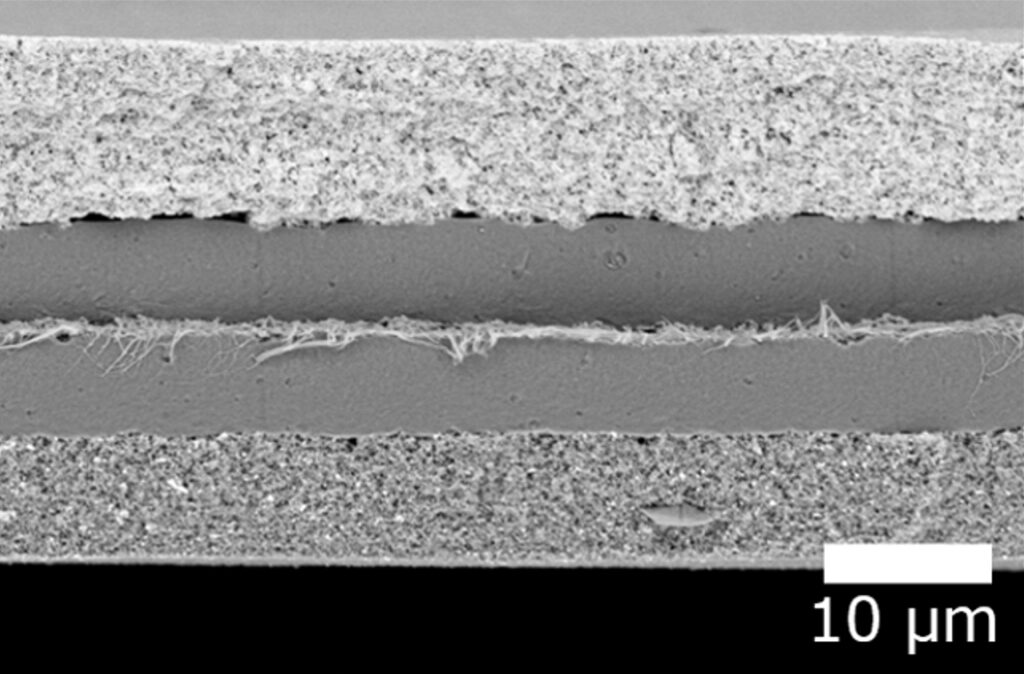
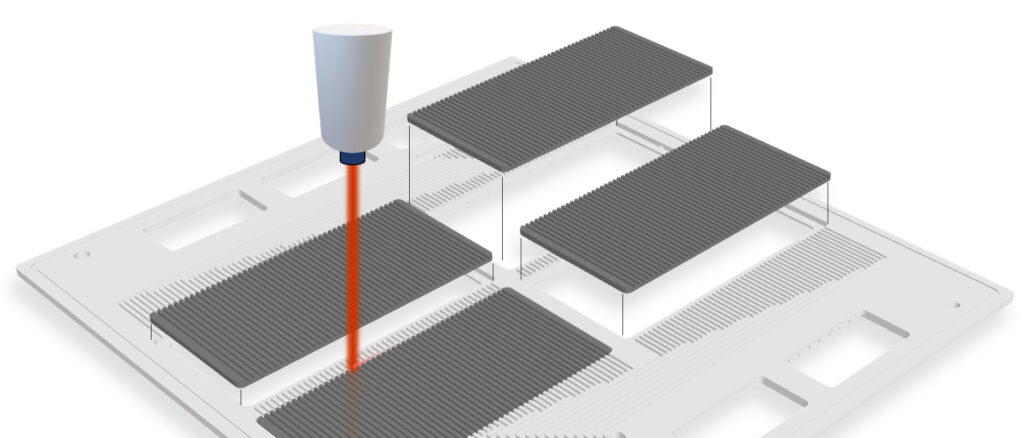
Illustration of the insertion of bipolar plate inserts into a polymer frame and their welding using a laser

Current manufacturing processes for graphite-based compound bipolar plates such as injection moulding, extrusion or hot pressing reach their limits with active areas of over 200 cm² due to the processability of the material. To increase the overall performance of the fuel cell stack, it is not enough to simply increase the number of cells. Especially as the internal electrical resistance increases steadily and the temperature and gas management as well as the mechanical load in the stack become more challenging.

Cells with a larger active area would deliver a higher total current at the same cell voltage and therefore more power per individual cell. A stack would therefore require fewer cells for the same total output.

New production process for larger
bipolar plates

In order to be able to produce larger graphitic bipolar plates cost-effectively in the future, ZBT is currently developing a production process for large-format bipolar plates for fuel cells together with SK Industriemodell.

The basic idea of the MC LaserBIP – Multi-component laser-welded bipolar plate – project is to integrate several graphite-based bipolar plate inserts into an injection-molded polymer frame. The laser transmission welding technology is intended to ensure the necessary precision, stability and hydrogen tightness for the use of the plates in PEM fuel cells. This process should also make it possible to produce large-format bipolar plates cost-effectively and efficiently. The researchers want to realise active areas of over 200 cm² for the first time.

The inserts and frames are manufactured using a cost-effective injection molding process. The process-related size limitation is circumvented by embedding small injection-molded inserts in larger frames. As the tools and equipment for these small elements are very cost-effective, the project partners expect that the manufacturing costs of the entire bipolar plate can be significantly reduced.

Focal points of the project

The researchers are paying particular attention to the choice of materials for both the compound inserts and the frames. They are investigating the suitability of the material with regard to the production of the plates, the welding process and the application in fuel cells.

Design, production, tests: The production process for inserts and frames will initially be validated using a 25 cm² prototype. In-situ tests under extreme conditions will provide further insights into the weld seam behavior, performance and degradation behavior. Bipolar plates with an active area of up to 200 cm² and multiple inserts will then be manufactured and tested in the laboratory within a short stack.

MC LaserBIP thus addresses a key challenge in fuel cell development: overcoming existing size limits to achieve freely scalable bipolar plate formats. The prospects of increasing the efficiency of fuel cell component production and reducing costs at the same time are certainly good.
Project information

Project title: MC LaserBIP – Multi component laser welded bipolar plate

Duration: May 2025 to April 2028

Project partners:

  • ZBT – The Hydrogen and Fuel Cell Center GmbH, Duisburg
  • SK Industriemodell GmbH, Übach-Palenberg

The project is funded by the European Union and the Ministry of Economic Affairs, Industry, Climate Protection and Energy of the State of North Rhine-Westphalia as part of the ERDF innovation competition “Industrie.IN.NRW”.

EU funding logo and logo of the North Rhine-Westphalia Ministry of Economic Affairs

Contact

Group leader graphitic stack development

Sebastian Brokamp
+49 203 7598-4286

Contact

Research assistant, graphitic fuel cell stacks

Dennis Tonder
+49 203 7598-1173
Portrait of a young man in a black shirt

Other current projects