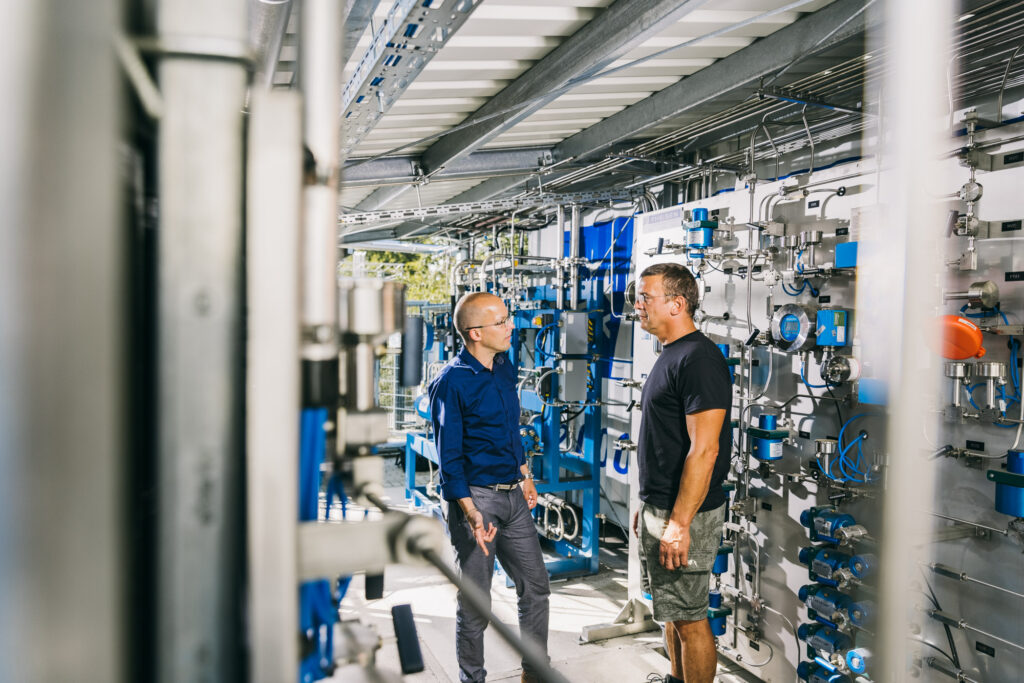
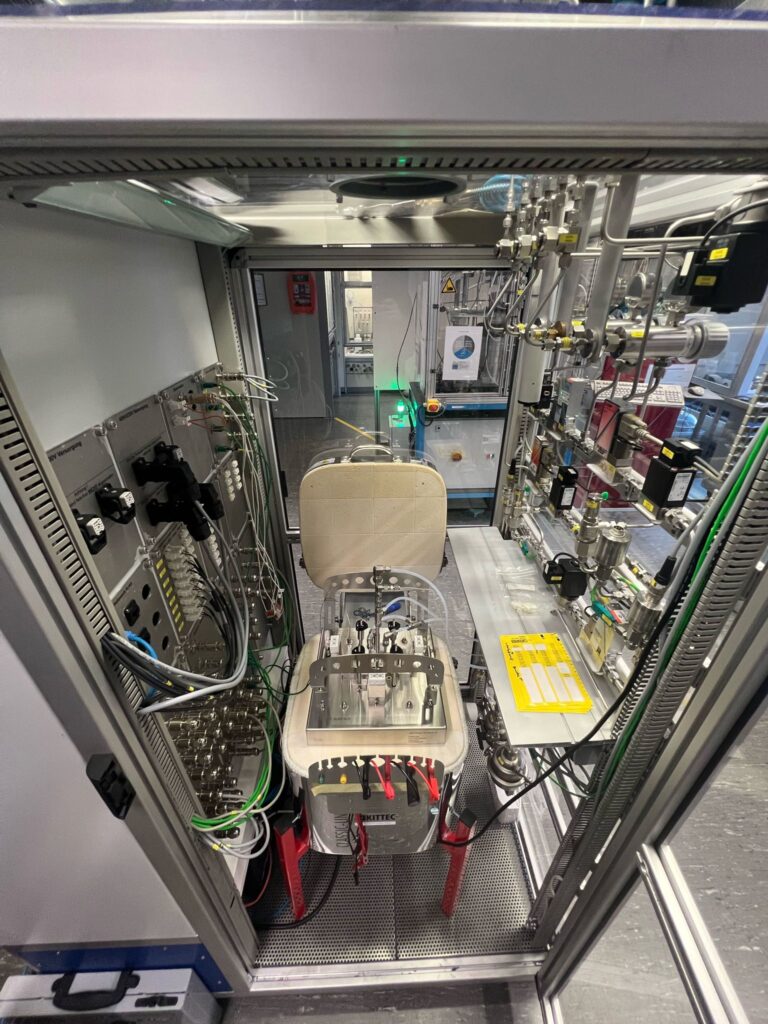
As part of the THERMOPEM project, a new measurement technology is being developed to determine the thermal contact resistance between thin, porous and anisotropic films. The measurement principle is based on contact-based electrical heating of the samples with non-contact temperature measurement. The surface pressure, temperature and humidity must be adjusted. In addition to the thermal contact resistance, the anisotropic thermal conductivity is also measured. Typical areas of application are power electronics, battery technology and fuel cells. The thermal optimisation of three-dimensional heat paths requires precise knowledge of the contact resistances and anisotropic thermal conductivities, which are not yet available or unknown. The aim of the project is to develop a measurement technique consisting of hardware and software. The novel method is being developed in the context of a practical application, with the membrane electrode assembly (MEA) serving as the core component of a PEM fuel cell (PEMFC) as a demonstration system. The functionality of the ‘thermo-optimised’ MEAs will be verified and quantified in fuel cell operation using 3D temperature distribution measurements. This will provide a fundamental understanding of the thermophysical relationships between the composition, structure and thermal properties of the components, the test conditions and the thermal properties of the composite. Measuring device developers (mainly SMEs) can use the new process to build and sell measuring devices, and measuring service providers can use them to offer measurements. The know-how is available to companies involved in thermal management, simulation and software development for power electronics, battery management and fuel cells.
Source:
https://jrf.nrw/forschung/detail/thermopem