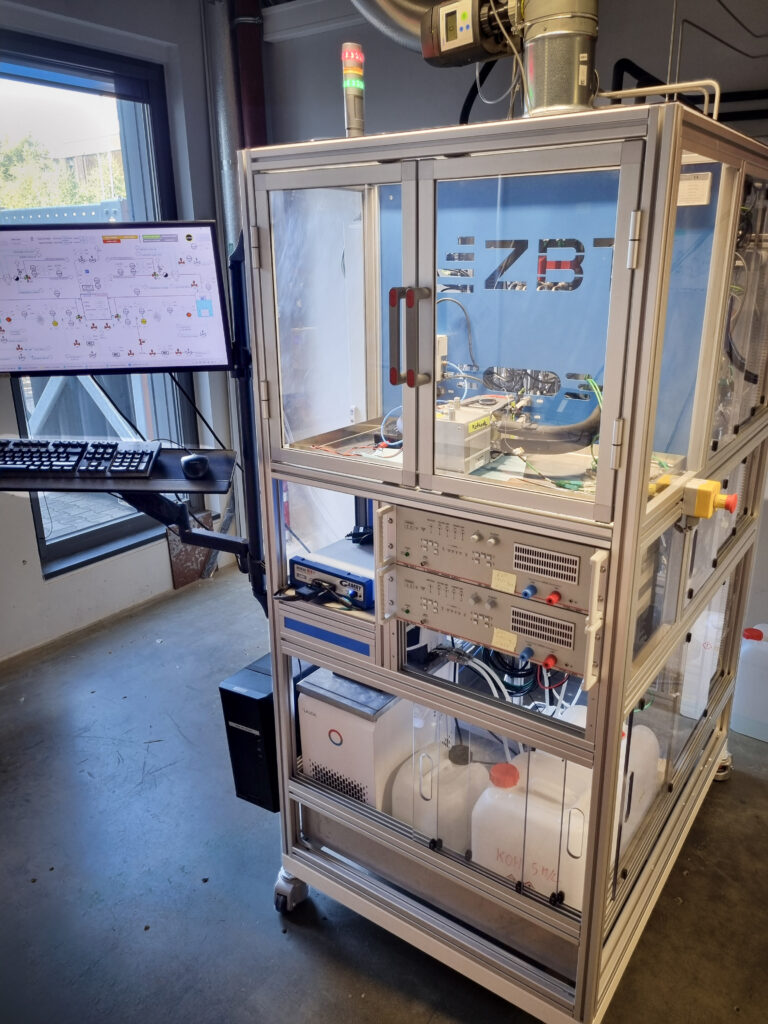
The core of the developments is the correct dynamic mapping of all components along the cathode path, including the fuel cell (ZBT). Based on these models, a model predictive control system is then developed which controls in particular the interaction between the compressor, the throttles and also the fuel cell load (IRT). The developments relate to a 10 kW fuel cell system that is being set up and measured at the ZBT and will ultimately be used to validate the model predictive controller.
Project summary:
The aim of the project is to develop a dynamic model of a polymer electrolyte (PEM) fuel cell, including the components relevant to dynamics, which is particularly suitable for use in model-based control processes, and to implement model-based control processes for optimising the overall operation of the fuel cell in order to increase efficiency while maintaining the same service life.
By performing dynamic measurements on the test bench, isolated dynamics are first measured in order to subsequently expand existing static models. Furthermore, comprehensive validation against two different fuel cell systems on the test bench is carried out to ensure the validity of the model in as many operating ranges as possible. At the same time, model-based control approaches are being investigated for their suitability and the most promising approaches are being implemented. With the help of a multi-step validation process, initially purely simulative, then in hardware-in-the-loop operation and finally on the test bench, the aim is to achieve an industrially viable solution.
The advantages of fuel cells are optimally exploited through the use of model-based control methods with tailor-made dynamic models of the fuel cell, including peripherals. On the one hand, the operating point of the fuel cell can be selected to be as energy-efficient as possible, while on the other hand, an operating parameter-dependent strategy for the fuel cell allows its operating range to be extended, thereby avoiding further undesirable reductions in service life.
SMEs throughout the entire value chain, from component manufacturers to system developers and system integrators, can benefit from the results by reducing obstacles to dynamic operation and achieving more economical and competitive operation.
Partners: